Spike Shoes
2015
with SLEM, Delcam/Autodesk, and Recreus
Social & Communication, Creativity & Aesthetics, Technology & Making, Design & Research Process
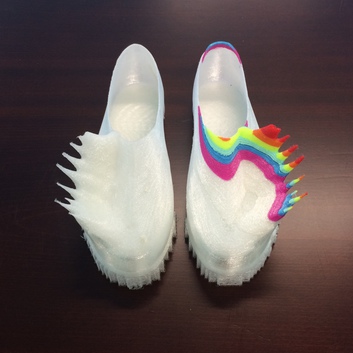
There is often a cognitive dissonance between what a user does in a shoe versus what the shoe was designed for. Many people wear tennis shoes although they do not play tennis. The difficulty being that tennis shoes are designed to the movements needed in a tennis match and are not adapt to walking long distances. In this project we wanted to create a shoe that presented a certain physical appearance (social fit) while performing for a different social need (behavioral fit).
While working with SLEM we partnered with Delcam/Autodesk Footwear and later material manufacturer Recreus to create soft and comfortable shoes. We started with a training at Delcam/Autodesk Footwear in Brighton, UK where we evaluated the possibilities of designing 3D shoes using the existing Crispin software suite. From there we traveled to Elda Spain to work with Recreus to print the shoes in their TPE FilaFlex. Using advanced slicing techniques we were able to control the density of material to make a shoe that is correct to the specific use of the wearer.
These shoes went viral as one of the first fully 3D printed shoes for women. They were designed based on the scans of feet and the spikes were initially devised as a test of how much material could self-support at an angle, but it led to a very successful aesthetic aspect that shows how 3D printing can change the expected aesthetics of footwear as it is no longer constricted by traditional construction techniques. The result is a shoe that appears artistic, but is adept at walking long distances.